
This concludes my blog for assessment as part of the Cybercultures Module for MA in Public Relations and New Media.
Thank you for reading.
This concludes my blog for assessment as part of the Cybercultures Module for MA in Public Relations and New Media.
Thank you for reading.
Everything about the picture I was staring at in my Twitter feed was wrong. But what really caught my attention was that t-shirt. Pink, sparkly and adorned with a dancing Minnie Mouse. My daughter, a devoted Minnie Mouse fan, had many similar versions of it neatly folded in her dresser.
More often than not she’ll insist on wearing one as I frantically try to dress her and get out the door to start our busy day. It would never occur to me that I wouldn’t be taking that same t-shirt off later that day and throwing it in the laundry bin, ready to wash away the stains of a happy few hours in crèche – paint, food, glue – nothing that wouldn’t wash out and guarantee another happy day of wear.
I had seen many horrendous pictures from the war that raged in Gaza over the summer of 2014. I found myself entranced by social media and its instant and continuous access to the situation as it was developing, for better or worse. It’s this up-to-date and uncensored news feed that I usually love about social media, but this time, it was those very things that kept me awake at night, tossing and turning.
I saw pictures of mangled bodies, most of them just children. Often they were lined up with their entire family, gone – just like that. Mostly I tried not to dwell on the incomprehensible horrors that were presented in front of me, like scenes from a tasteless war movie. But there was something about this picture that I couldn’t turn away from. Maybe it was the Minnie Mouse t-shirt, or maybe it was the lifeless little body that wore it.
The little girl was no more than a toddler. She lay there on that cold steel table, dead. She was blackened by whatever faith had befallen her, maybe it was from the debris from which she was pulled or perhaps a bomb or missile that exploded close by. Or maybe nobody knew why this little girl was dead.
As I lay in bed thinking about the girl in the Minnie Mouse t-shirt, so many questions went through my mind. What was her name? Did she have a family? Were they dead too? So many things I wanted to know about this girl I never met, yet who I felt I knew. This nameless victim that social media had brought into my home.
In the days that followed I grieved for that little girl, for her siblings and for her parents. But mostly, I grieved for this awful world we live in, where the picture of a dead child has become the norm. Where it takes something exceptional for us to even allow ourselves to register the horrors that lay in front of us. What have we become?
There are many who believe we shouldn’t be exposed to pictures like this. That social media lacks filters. But the truth is often uncomfortable. And the more uncomfortable the truth makes us, maybe the more it needs to be told. That child was innocent, one of hundreds of innocent children who were murdered over the long weeks of that summer. Her only crime was where she was born, the wrong side of the barrier.
That picture was all she had to give now. The hope that the world would be awakened at the sight of her cold dead body and that somebody would call ‘Stop’. I’m glad I saw that picture on Twitter, I’m glad it reached out to me and woke me up. Over the following weeks I joined the marches calling for a stop to the war on Gaza. I brought my daughter with me and hoisted her high on my shoulders. She wore her Minnie Mouse t-shirt and together we called for justice for the children of Palestine #FreePalestine

The rise in citizen journalism means that organisations need to constantly monitor what is being said about them both off-line and on-line. Public relations professionals need to be the ‘ears’ and ‘eyes’ of an organisation and seek out what is being said about the brand.
There are many free tools available to do this – Twitter advanced search, Google alerts and socialmention.com.
While it is possible to mostly control what appears on a company’s own social media news feeds using word filters and administrative pre-approval of comments, it is impossible to control hashtags associated with an organisation.
McDonalds learned this the hard way when in 2012 they created the hashtag #McDStories in the hope of inspiring people to share their memories and happy experiences associated with the fast food chain. The company soon discovered that it is the public who control the meaning of hashtags, and theirs was quickly hijacked to become the hashtag for horror stories involving McDonalds.

Burger King suffered a different kind of social media crisis when in 2013 its Twitter account with 82,000 followers was hacked. The hacker changed their logo and twitter handle to that of McDonalds and tweeted a huge number of tweets containing inappropriate contents and images. The hack went unnoticed for hours, by which time the incident had gone viral. The company not only learned an important lesson about password security and the need for moderators, it also experienced first-hand what happens when you are not constantly listening on-line. On the plus side, the food chain gained thousands of new followers because of the incident.

Despite often having ‘expert’ social media teams, some of the biggest and most tech-savvy organisations continue to suffer social media fails. Last year The Guardian published an article on The top five corporate Twitter fails and it makes for some very uncomfortable reading.
The moral of the story is, it’s no longer just your P’s and Q’s you need to mind, watch your Hashtags too….


Ever feel like Big Brother is watching your every move?
Well he is. Except it’s not a he, it’s an app. And with Forrester predicting Europe’s online retail sales will hit €191bn by 2017 it is easy to see why.
MappedIn describes mobile marketing, or geo-targeting, as targeting consumers with relevant products while they are in the location. They say this will make mobile marketing more relevant and less intrusive, changing the way mobile marketing is executed.

Mobile marketing has now become an important part of the overall marketing mix. According to Adam Grunwery, M.D. at Searchable Digital Marketing Agency social media networks, like Facebook and Twitter, are increasingly using fans locations through third party installed apps to allow them provide additional marketing opportunities for businesses. Location based apps or ‘lo-so’ networks like Foursquare and Loopt enable any business with a physical location to not only communicate with customers on-line, but actually get more of them to walk in the door.
Over half of all internet browsing now happens on mobile devices. Smartphone users research information and make their purchases while on the go – on the bus, in work or even in the supermarket checkout queue. This is the beauty of location based marketing, it brings the product to you – a bit like having your own virtual personal shopper.
Except this personal shopper doesn’t clock out at 6 p.m., this one follows you home and helps you through your sleepless nights at 4 a.m. Spot of early morning shoe shopping anyone?

‘The next wave in social media marketing will be harnessing the power of location based technology’ that’s according to Kevin Alansky, CMO of SocialRadar.com. He believes that by understanding customers location patterns, companies can better predict the users behavior. This allows companies to create the perfect marketing opportunity – right product in the right place.
Strategic product placement at its best. Kind of like steering you into the wine section on a Friday evening. It would be rude not to….wouldn’t it? The future of social media marketing is bright and it’s most certainly mobile…Even if it is a little bit of a stalker.

The 2014 Celebrity Photo Hack
On August 31, 2014, almost 500 private pictures of various celebrities were posted on the imageboard 4Chan, and later shared on social media sites all over the world. Most of the pictures were of women, and many contained nudity.
The pictures are believed to have been taken by hackers from a breach of icloud, Apple’s cloud service, in what was described as “a very targeted attack”.
Reactions
The celebrity photo hack was met with varying reactions from the media and fellow celebrities. Some felt it was a gross invasion of privacy, others blamed the celebrities for keeping such pictures on their devices.

Jennifer Lawrence was one of the celebrities involved and one of the first to confirm the photos were genuine (many others denied their authenticity). In an interview with Vanity Fair she called the breach a “sex crime” and a “sexual violation”.
“Anybody who looked at those pictures, you’re perpetuating a sexual offence. You should cower with shame”
Jennifer Lawrence to Vanity Fair
But what was it about this crime that allowed people to blame the victims?
Was it the fact that it was a cyber-crime? Or because the victims were celebrities?
I think, in truth, the internet has desensitised us. We are so used to seeing the intimate details of peoples lives online, that we no longer view anything as off limits.
We have become a nation of peeping Toms and instead of blaming the person who cut the hole in the wall, we blame the person being watched.
And while some of this voyeurism may be passed off as ‘just another part of the celebrity culture’, much of it has crossed the line and become gross invasions into peoples lives.
Of course, celebrities themselves have helped blur these lines, as many of them seem to openly encourage this violation of their privacy. There are plenty of ‘celebrity sex tapes’ out there, which were strategically placed in the ‘wrong’ hands.

Take Kim Kardashian (or Kar-crash-ian, as my friend likes to call her), who recently attempted to “break the internet” by publishing supposedly ‘tasteful’ nudie pictures. In my opinion, the pictures were inappropriate and had no place in the public domain. The world doesn’t need to see Kim Kardashian balancing a champagne bottle on her extraordinarily large rear-end. I certainly didn’t anyway.
It’s hard for modern day celebrities. Privacy can be difficult to find. Some welcome the invasion of their personal life, others most definitely do not.
As surfers of the internet, and consumers of celebrity scandal, we need to make a stand on what’s acceptable and what’s not. We need to remember our morals and social norms. We need to remember the difference between what is right, and what what is not.
And most importantly, we need to remember that when someone is sexually violated, whether online or offline, they are still the victim.
Here Paul Levinson, Professor of Communiations and Media Studies at Fordham University, talks about this new phenomenon he calls ‘Citizen Porn’ and the need for better online laws to protect our personal data.
Are you being annoyed by your employer sending out of hours emails? Well, it may soon be illegal for them to do so – in Germany anyway.
German employment minister Andrea Nahles is considering new “anti-stress” legislation, banning companies from contacting employees out of hours. The move is a reaction to rising levels of workplace stress in the country.

“There is an undeniable relationship between constant availability and the increase of mental illness. We have commissioned the Federal Institute for Occupational Safety and Health to work out whether it is possible to set load thresholds. We need universal and legally binding criteria” according to Nahles
It is already illegal in Germany for employees to contact staff during holidays. Several major companies such as Volkswagen and BMW have also implemented their own restrictions on contacting employees out of hours.
Recently, car manufacturer Daimler installed software on its systems which automatically deletes emails sent to staff out of hours.
Sounds like a dream come through, doesn’t it?

That’s one of the problems living in the digital age, we are always ‘on’. Your employer most likely wouldn’t ring your land line at 11 p.m. on a Friday night, but probably wouldn’t think twice about sending an email.
Social Etiquette
There’s almost a sense that on-line communications are virtual, and therefore don’t warrant the same social norms as regular off-line communications. And because we are all pretty much on-line 24/7 now, there’s an expectation that you are available 24/7 too.
Gone are the days of clocking out of the office and retreating to your private life. Your private life is now interlinked with your professional life, especially if you are a social media user.
So, when your boss sends you that email at 11.00 p.m., it’s not acceptable to say you didn’t receive it, your boss has already spotted you active on LinkedIn or Twitter, and knows you’re online.
Mental Health
Is it any wonder then that mental health issues are spinning out of control in Ireland, with an estimated one in four people affected. Being unable to switch off because of technology and the changes in how we communicate, are becoming a major cause of anxiety, stress and sleep deprivation.
The growing connection between work and mental health issues led to the HSE recently publishing a guide to help employers reduce the likelihood and effects of work related stress.

It’s a small step in the right direction, but not nearly enough to really make a difference.
What Now?
Will Ireland follow Germany’s lead and make it illegal for employers to contact employees outside of work hours? Only time will tell. In the meantime, when you clock out at 5.30, make sure you clock out on-line too.

Being an avid supporter of civil rights and the freedom of speech, I solemnly supported the online campaign following the slaughter of twelve innocent employees at the Charlie Hebdo magazine in France. The world was in shock at this brutal assault against the press. The hashtag #JeSuisCharlie began trending around the world in the days that followed the attack and became the tagline for standing up for our democratic right to freedom of expression.
Three days after the attack, a unity march took place in Paris showing the world that freedom of the press could not be quashed by this cowardly attack on democracy. Over two million people took to the streets that day, including government representatives and dignitaries from around the world. The world stood hand in hand in defiance against the perpetrators of this heinous crime. The message was clear – the modern world would not accept this attack on the freedom of the press. Noble indeed. Even if some of those leading the march that day, were in fact, some of the greatest perpetrators against our right to freedom of information.
Compare this fantastic reaction to that when tech whiz-kid and political activist , Aaron Swartz, took his young life on 11th January 2013. Swartz, often referred to as a ‘hacktivist’, believed in a free and open internet, whose information should be available to all. He was involved in the development of numerous open source software, including web feed format RSS, Creative Commons, web.py and social news site, Reddit.
Swartz was passionate about sociology, civic awareness and activism and was involved in a number of on-line groups devoted to these causes. He founded Demand Progress, who passionately campaigned against the Stop Online Piracy Act, which the United States government were attempting to bring into law to help combat copyright infringement and online trafficking in counterfeit goods. Swartz, along with other opponents to the Bill argued that the proposed legislation threatened free speech and innovation as it would allow the government to block access to entire internet domains due to infringing content posted on a single blog or webpage.
On 18th January 2012, Google, Wikipedia and 7,000 smaller websites coordinated a service blackout in protest against the Bill. The following day, ‘hacktivist’ group Anonymous blocked access to the websites of several major organisations who were pro the proposed Bill. On 20th January 2012, the House Judiciary Committee postponed plans to draft the Stop Online Piracy Act. The US government have yet to revisit the Bill.
This victory may have been celebrated by those who coordinated the online efforts against it, but for Adam Swartz, it was a bitter-sweet victory. Swartz had been arrested the previous January after systematically downloading academic journal articles from JSTOR, a digital library. He was charged with two counts of wire fraud and eleven violations of the Computer Fraud and Abuse Act. The maximum penalty was 35 years in prison and a $1 million fine. After refusing a plea bargain in 2013, Swartz was found dead in his Brooklyn apartment, aged just 27.
Swartz’s crime had no discernible victims or personal financial gain. JSTOR declined to pursue charges, yet the US Attorney seemed to pursue the case with zeal, taking many by surprise. Of course, this was in the post-WikiLeaks world, where powerful governments and organisations were struggling to cope with the threat posed by internet hackers. It seemed that Swartz was to be made an example of and pay the ultimate price for his attempt to open up the freedom of online information.
Two years following his death, the White House has yet to respond to a petition calling for the firing of those in the Justice Department for their handling of the Aaron Swartz case. It seems that Aaron Swartz will have to wait a little while longer to have his #JeSuis moment.
Aaron Swartz (RIP 1986 – 2014) We can change the world

According to Stacey M. Koosel in her article Exploring Digital Identity: Beyond the Private Public Paradox, in the same way that new media is transforming culture, we are transforming ourselves into digital identities. These identities may be an extension of our ‘true’selves, or they may be completely fabricated to mask our true identity from the rest of the world.
Digital identity basically refers to the identity which people create when using a computer with the purpose of interacting on-line. The problem with these on-line personas is that unlike meeting people face to face, where you have a reasonable chance of picking out the ‘crazies’, most people you interact with on-line you never get to meet. That means that Kassie, the busty American model, who wants to be your new best friend forever, may in fact be Patrick, the criminal from Dublin, who just wants your credit card number.

What was once integral – our self, our person, our identity – is now split among ourself in the physical world and our many digiselves, each having an autonomous life of its own (Federman). Even if you are not the type to create a whole new on-line identity, most of us find it hard to resist the urge to be a slightly more ‘enhanced’ version of ourselves. Perhaps we are all a little schizophrenic at heart.
I’m sure if we looked at the vast majority of people’s Facebook accounts, we would mostly see the wonderful aspects of their lives – adoring significant others, fabulous friends, a cat whose litter tray smells like roses – you get the picture. After all, who would want to show their real, slightly boring and very often imperfect lives to the universe. Not me….but I chose the ‘not sharing my entire life’ tactic, not the ‘Walter Mitty’ one.
This whole phenomenon of fantasy on-line identities has given rise to the phrase ‘catfish’ which the Urban Dictionary defines as:
A catfish is someone who pretends to be someone they’re not using Facebook or other social media to create false identities, particularly to pursue deceptive online romances.
The concept was used by Henry Joost and Ariel Schulman to create a 2010 documentary, also called Catfish, which follows the blossoming relationship of Nev and a woman he meets on Facebook. The film went on to inspire an MTV reality series of the same name.
I guess the moral of the story is to treat those you interact with on-line as what they are – strangers. And remember what your mom always told you, don’t get into cars with strangers, even if it is for a virtual ride.

According to the Open Source Initiative open source software is software that can be freely used, changed and shared (in modified or unmodified form) by anyone. The movement branched out from the Free Software Movement that began in the 1980s with the launch of the GNU/Linux project by Richard Stallman and the basic concept was that it would be a form of free exchange of programming code.

Much of the online software we use today is open source, even though we may not be aware of it, or necessarily modify it ourselves in any way. Some of the more commonly used open source software are Mozilla Firefox, Google Chromium, Android and OpenOffice.Org.
One of the effects of the movement has been the emergence of the phenomenon of citizen journalism. We all now have the tools we need to research, compile and publish information, without ever having to leave our homes and at very little cost. The vast majority of those who engage in online communications are now publishers – through blogs, microblogs, wikis, instagram, you-tube, and the many more free platforms available.
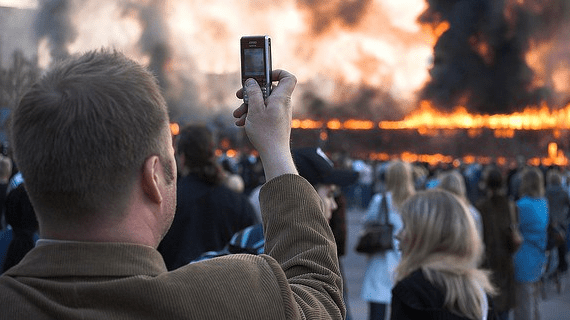
According to the Citizen Journalism and World Trade Organisation, citizen journalism allows us to “play an active role in the process of collecting, reporting, analysing, and disseminating news and information.” Never before have public citizens had such power and such an ability to be heard. Instead of undergoing the time-consuming and often costly traditional research methods, journalists (and citizens) can now source information directly from those involved.
We no longer need to be trained programmers, web designers, journalists or videographers to produce and publish good quality work. All we need now is a basic knowledge of technology and with the click of a button, we can reach an audience of millions, worldwide.
As people become more suspicious of mainstream mass media, there has been a turn away from the more ‘structured’ and ‘professionally produced’ material towards what is viewed as more unbiased and authentic material. This is often evident at times of war or political unrest, where people turn to the likes of Twitter for information rather than the more formal news sites. In fact, many stories now break on Twitter before they make the mainstream press.
As the tragedy of the bombings at the Boston Marathon in 2013, and the subsequent pursuit of those responsible began to unfold, much of the information and footage used by the mainstream media relied heavily on citizen updates in the area though videos, pictures, tweets and skype calls, among other on-line mediums.
The following amateur footage of the bombings was used by the Boston Globe when reporting on the tragedy. The newspaper bought the footage from its creator and now own the copyright.
When citizen journalism first emerged it was often looked ‘down on’ and viewed with suspicion by professional journalists. I think the more both groups become acquainted, the more they realise that there is a valuable place for both their skills in the modern age of mass media. A recent blog published on storyful.com noted that:
“The proliferation of citizen journalism through social media has added a new dimension to reporting that traditional media are understandably keen to latch on to. Not only do citizen journalists offer a perspective different from that of the professional cameraman, they also frequently capture moments that news media cannot – often simply because they are eyewitnesses or in remote or dangerous locations.”
The open source movement has changed more than just technology, it has changed society and how we communicate. I’ll leave the last word to the man credited as being the founder of the free source movement…


Have you checked out your social media footprint lately?
Well, maybe you should.
Here’s why…
Jobvite’s 2014 annual Social Recruiting Survey shows exactly what hiring managers are looking for when they check out your social media sites.
And the results may shock you.
The data shows a staggering 93% of bosses are checking out potential employees social media profile before making a final hiring decision. Of these, 55% admit to reconsidering a candidate based on what they found online.

Employers note the biggest turn-offs on potential candidates on-line profiles as including any reference to drugs, poor grammar and spelling, and any reference to sexual activity.
On the plus side, most employers are engaging social media to recruit staff now, with 94% using LinkedIn and 64% using Facebook to advertise a job. In fact, 73% of all jobs offered are now filled through social media.
Starting to panic?
There are various sites available to check out your social media footprint. Or anyone else’s you may have an interest in…just saying.
Google and Google Images are a good starting point. Then there’s Pipl.com and Spezify.com if you want to up the ante on your stalking. You can even check for a criminal record. Gives a new meaning to the whole concept of ‘checking references’.
How can you make this right?

In truth, it’s difficult. Check out this article on How easy it is to delete yourself from the web
I’m sure the day will come, and very soon, where we will be able to contract a company to erase our social media history, at an affordable price. It may not too bad for those of us who only discovered social media in our twenties, when most of our crazy days were behind us, but for those who grew up in the shadows of social media platforms, it really is a different story. For many, their social media history created in their carefree teenage years, may haunt them long into their thirties and beyond.
Surely this isn’t fair or right? Or is it? Is this the true meaning of freedom of information?
Check out this social media experiment carried out by Jack Vale Films. It’ll make you think before you post…


